Employer branding videos: 10 Belgian examples that work
Employer branding videos: 10 Belgian examples that work
The best employer branding examples show real employees, real workplaces and real answers to what candidates want to know. No glossy image film, but short videos that feel native in the feed. Below you'll find 10 Belgian cases, each with the challenge, the approach and the lesson you can take home.
All examples come from SnakLab's own work, the video brand of Student.be. From hospitals to banks and construction: the sectors differ, the principles don't.
What makes an employer branding video work?
Three things come back in every strong example. One: a real face. Young people believe a colleague, not a voice-over. Two: a concrete answer to the questions candidates actually ask, atmosphere, content, growth. Three: distribution. The video has to show up where the audience scrolls, not just on your career page.
Keep those three criteria in mind for every example below. You'll recognise them each time.
Something else stands out: not a single example is really about the employer. Every video starts from the candidate. What do they want to know, see and feel before applying? That perspective is the real difference between a company film and employer branding that works.
10 employer branding examples from Belgium
1. Sint-Trudo: recruiting nurses
Challenge: nursing is a persistent shortage occupation. Every hospital fishes in the same small pool. Approach: short videos that show the real work on the ward, distributed on the channels where young healthcare profiles hang out. Why it works: healthcare candidates choose on atmosphere and team, not on pay scales. Show the workplace honestly and you win trust. Lesson: show the ward, not the building.
2. Beobank: employer branding for bank employees
Challenge: a bank is rarely seen as a hip employer by young talent. Approach: employer branding videos in which employees themselves talk about their job and growth opportunities. Why it works: it breaks the dusty image with proof instead of slogans. Lesson: if you have a perception problem, let your people prove the opposite.
3. EEG: recruiting sanitary installers
Challenge: technical profiles like installers rarely search actively; a vacancy alone mostly reaches people already looking. Approach: short-form videos that show the trade as it is, distributed to young people with a technical interest. Why it works: the audience decides in the TikTok and Instagram feed whether an employer speaks to them, often before they even open a vacancy. Lesson: back up your vacancy with video on the channel where your audience already is.
4. Zorgbedrijf Antwerpen: attracting nurses
Challenge: standing out as a large healthcare organisation between all the other care vacancies. Approach: authentic videos with in-house care workers, cut for the feed. Why it works: scale isn't an argument for a candidate, humanity is. Lesson: the bigger your organisation, the smaller and more personal your video should feel.
5. Vivalia: recruiting nursing interns
Challenge: convincing nursing students to do their internship at your hospital. Approach: videos that speak the student's language, distributed via the Student.be database of 600,000 young people. Why it works: whoever wins the interns wins the future employees. Lesson: start your employer branding earlier in the funnel, with students.
6. CHU-UCL Namur: recruiting healthcare workers
Challenge: reaching healthcare workers in a region where every institution goes after the same profiles. Approach: short, relatable videos about the job, tightly targeted by region and profile. Why it works: regional targeting avoids wasted impressions. Lesson: combine a strong story with smart geographic targeting.
7. AZ Sint-Blasius: student workers in healthcare
Challenge: getting student workers excited about a sector they rarely consider spontaneously. Approach: light short-form content that shows what a student job in the hospital actually looks like. Why it works: a student job is a low-threshold first step into the sector. Lesson: use student jobs as an entry point for your future intake.
8. Colas: attracting young engineers
Challenge: young engineers more often pick consultancy or tech than road construction. Approach: videos that show the impact and the projects, aimed at students and young graduates. Why it works: engineers choose challenge and visible outcomes. Lesson: sell the project and the impact, not the org chart.
9. Régie des Bâtiments: recruiting site managers
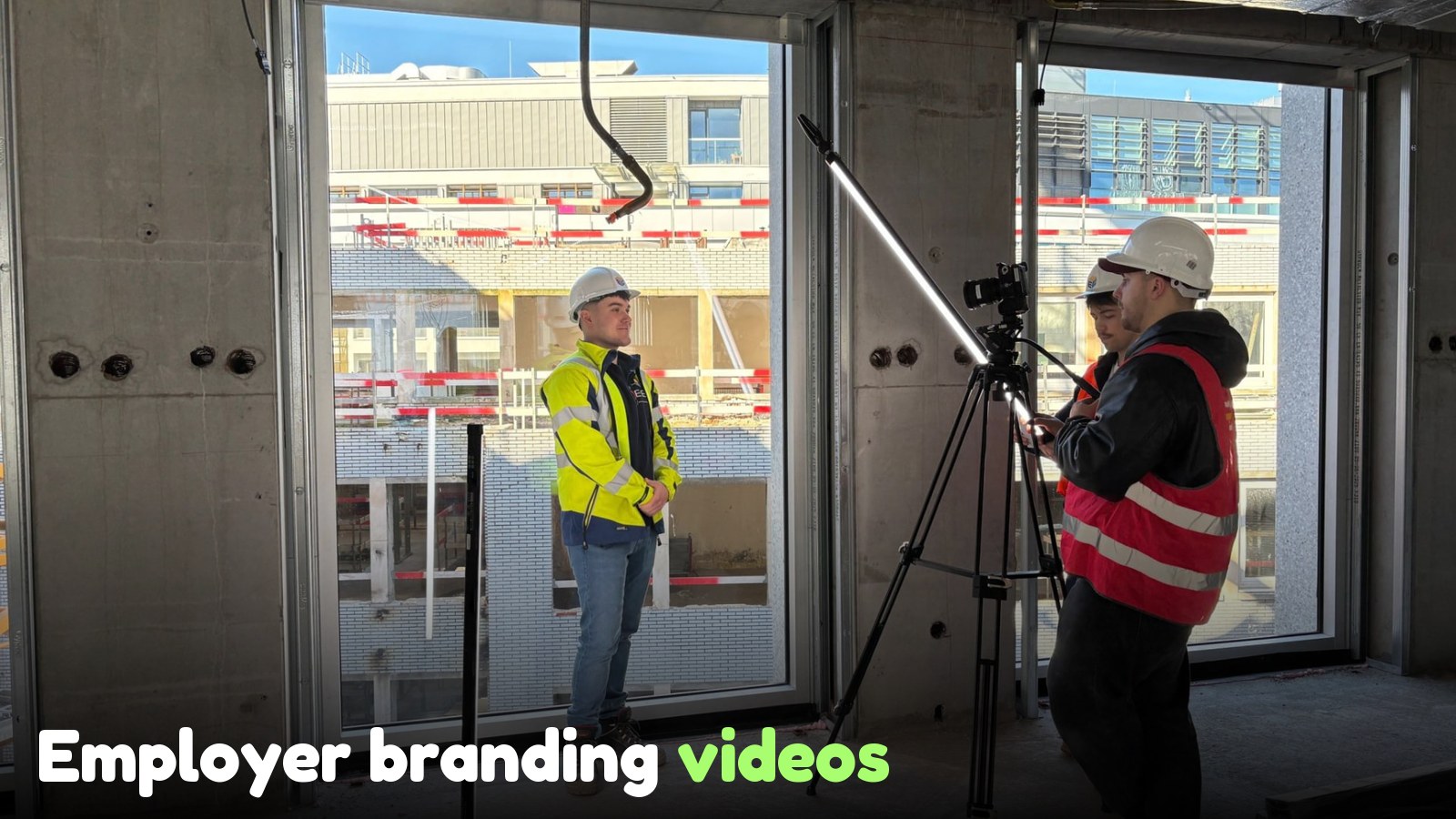
Challenge: a federal public service looking for site managers, against the cliché of "boring government". Approach: videos shot on the construction site itself, focused on the responsibility and variety of the job. Why it works: the site is more visual and more dynamic than any studio. Lesson: your workplace is often your strongest backdrop, use it.
10. Deloitte: job fair aftermovie
Challenge: keeping the energy of a job fair alive, also for those who weren't there. Approach: a fast, native aftermovie that captures the vibe and lives on social media. Why it works: one event becomes weeks of content and proof of your work culture. Lesson: every physical event deserves a short-form extension.
What do these employer branding examples teach you?
Four threads run through all ten cases:
- Real people beat actors. Every strong video is built around an employee, intern or student.
- Shortage occupations need extra channels. Healthcare, technical and construction profiles rarely search actively; video in the feed reaches them before they open a vacancy.
- Distribution is half the work. Every case combines content with targeting and the Student.be network.
- Short and native wins. No video feels like an ad. Everything is made for the feed, in 9:16.
How do you apply these examples to your organisation?
Don't copy the video, copy the logic. Start with your biggest recruitment problem: a shortage occupation, an image problem, or too few young people coming in. Then pick the example closest to it.
Struggling with perception? Do what Beobank did: let employees prove the opposite. Looking for scarce technical profiles? Follow EEG and the Régie des Bâtiments: shoot the trade on the shop floor. Want to build a young pipeline? Do like Vivalia and AZ Sint-Blasius: focus on interns and student workers.
Then plan your distribution right away. Every example above combined content with targeting and the Student.be network of 600,000 young people.
Want to know how to set this up on TikTok? Read this next: TikTok for employer branding: how to recruit young talent in 2026.
Frequently asked questions
What is an employer branding video?
An employer branding video shows who you are as an employer: your people, your workplace and your culture. The goal isn't to fill one vacancy, but to make candidates think: "that's where I want to work". Short, authentic videos on TikTok and Instagram work best for young audiences.
Read more in our article on using TikTok for employer branding campaigns targeting young people.
How do I get started with employer branding videos?
Start with one format, for example a "day in the life" of an employee. Pick a colleague who enjoys talking, shoot vertically and keep it under a minute. Plan your distribution up front, otherwise your video stays invisible.
How much does an employer branding video cost?
The price depends on the concept, the number of shoot days, the edit and the distribution. A monthly content package brings the cost per video down. Ask for a tailored proposal.
Does employer branding work for small organisations?
Yes, often even better. Small teams feel more personal, and authenticity is the whole point. One smartphone shoot and targeted distribution are enough to reach the right candidates in your region.
Ready to become the next example?
These ten organisations started from the same point as you: vacancies that stayed open for too long. See some of our videos or book a call with SnakLab. We think along from concept to distribution among 600,000 young people.